| ANNONCES | |
| Prix de thèse GREMI - Michel CHIGNARD 2025 | |
 Alberto Iannuzzo |
|
 |
Titre : Déchiffrer les mécanismes responsables de la pathogénicité des variants de CDC42 iden]fiés dans les Université Paris Cité |
Deux membres du GREMI, Véronique Witko et Valérie Urbach ont été nommées représentantes françaises au conseil de gestion de l'action européenne COST, EU-RESOLVE. EU-RESOLVE vise à créer un réseau d'excellence paneuropéen et multidisciplinaire en biologie de la résolution de l’inflammation. Ce réseau réunit des universitaires, des cliniciens, des entreprises de biotechnologie et d'autres acteurs. EU-RESOLVE vise à mieux comprendre les mécanismes qui régulent la résolution de l'inflammation et à accélérer la traduction de ces résultats en traitements plus efficaces pour les patients atteints de maladies inflammatoires chroniques. EU-RESOLVE présente un intérêt majeur pour tous les scientifiques intéressés par les mécanismes sous-jacents à l'inflammation en couvrant largement les maladies chroniques, les divers organes et types cellulaires impliqués et les multiples approches expérimentales développées. EU-RESOLVE offre un fort potentiel pour le développement de nouvelles collaborations européennes. En tant que chefs d'équipe/de groupe, chercheurs confirmés ou juniors, n'hésitez pas à rejoindre un groupe de travail EU-RESOLVE ou à contacter valérie.urbach@inserm.fr En plus de Véronique et Valérie, trois autres membres du GREMI sont impliqués dans EU-RESOLVE (Sylvain Perruche, Marc Dubourdeau et Xavier Norel). |
|
|
|
| Webmaster X. Norel © 2024-2027 GREMI, tous droits réservés |
|

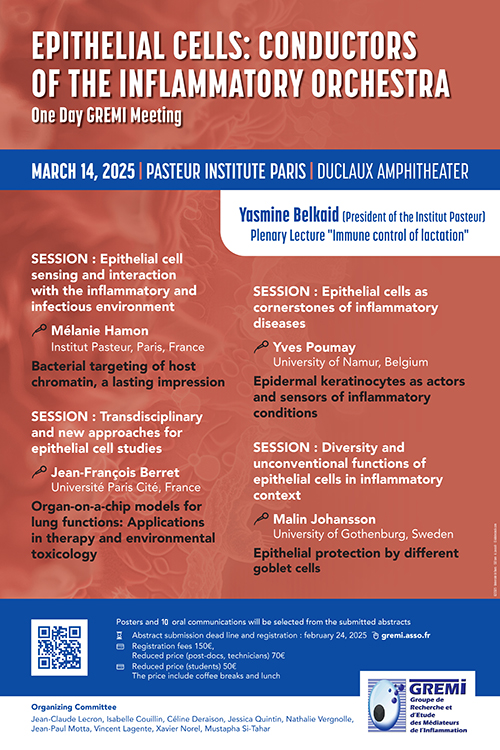
 La Journée GREMI du 14 Mars 2025 "Epithelial Cells: Conductors of the Inflammatory Orchestra" à l'Institut Pasteur fut un succès avec 130 participants.


3 Symposium GREMI au WCI2026:
09/09/2026: Symposium 1 (Resolution of Inflammation)
chair persons (Vanessa Pinho & Xavier Norel)09/09/2026: Symposium 3 (Mucosal Immunology and Microbiota)
chair persons (Nathalie Vergnolle & Angelica Thomaz Vieira)11/09/2026: Short Symposium 9 (Thromboinflammation)
chair persons (Véronique Witko & Benoit Ho-Tin-Noé) _________________________________________
Activités récentes du GREMI
_________________________________________
Xavier Norel, Valérie Urbach, Véronique Witko, Sylvain Perruche et Marc Dubourdeau (avec le GREMI)
ont co-organisé ce congrès
_________________________________________
Affiche (pdf, A4) de la Journée GREMI à imprimer
Photos du meeting_________________________________________
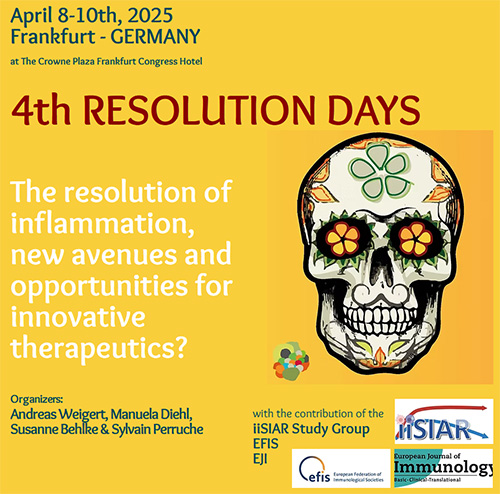
Sylvain Perruche (membre du GREMI) a co-organisé ce congrès_________________________________________
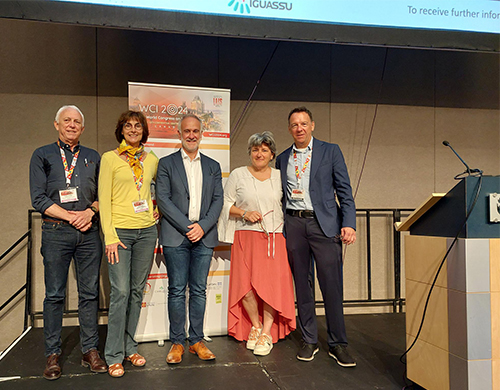
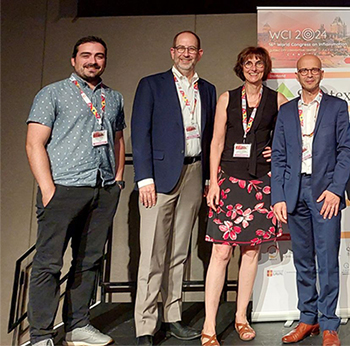
3 membres du GREMI (Nathalie Vergnolles, Véronique Witko-Sarsat, Xavier Norel), avec le président de l'International Association of Inflammation Societies (IAIS), Dr. Jason McDougall (au centre), et le responsable de l'organisation locale Dr. Marc Pouliot (Université Laval, à droite)Le GREMI était impliqué dans l'organisation du WCI2024 avec 2 Symposium :
Symposium sponsored by the GREMI and Ambiotis:
Novel Points of Control of Lung Inflammation
Chairs: Dr. Véronique Witko-Sarsat, Dr. Mustapha Si-Tahar (à droite ci-desssous)
avec Dr. Erwan Pernet et Pr. Bruce levy (de gauche à droite)
- Effect of CFTR modulators on lung inflammation and neutrophil functions in cystic fibrosis - Dr. Véronique Witko-Sarsat, Institut Cochin, France
- Neonatal cross-talk of alveolar macrophages and neutrophils regulate lung inflammation
Dr. Erwan Pernet, Université du Québec à Trois-Rivières, Canada
- Metabolic control of virus-induced lung inflammation
Dr. Mustapha Si-Tahar, Inserm-CEPR, France
- Specialized pro-resolving mediators in respiratory diseases
Pr. Bruce Levy, Brigham and Women’s Hospital, USA
Symposium Brazil - GREMI (France) sponsored by Solutex:
Lipid mediators for resolution and beyond
Chairs: Dr. Mauro Teixeira, Dr. Xavier Norel- SPMs in atherosclerosis and aging
Dr. Gabrielle Fredman, Albany Medical College, USA
- Maresin and SPMs in human arteries and heart, interactions with PGE2 pathway
Dr. Xavier Norel, INSERM U1148, Sorbonne Paris Nord University, France
- Novel molecules and mechanisms resolving inflammation, suppressing fibrosis
Dr. Catherine Godson, University College Dublin, Ireland
- Abnormal resolution of inflammation in Cystic Fibrosis: A role for Specialized Proresolving Mediators
Dr. Valérie Urbach, INSERM, Université Paris-Est-Créteil, France
_________________________________________
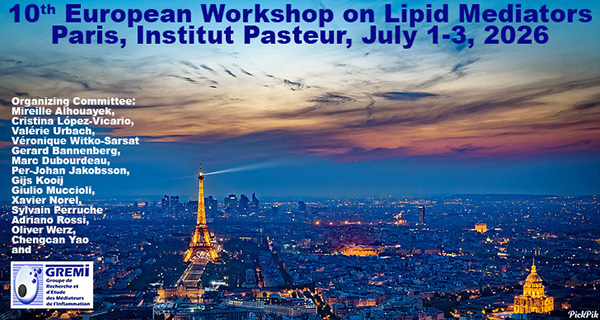
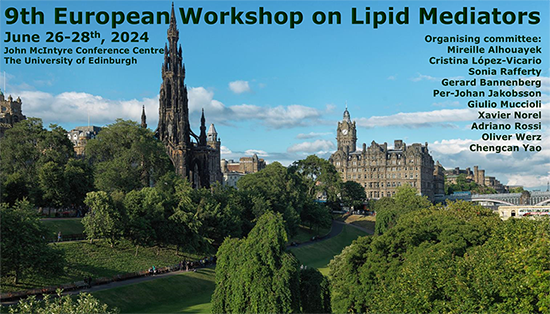
Le GREMI participe (Xavier Norel) au 9EWLM Bioactive Lipid Meeting
organisé par l'ESLM à Edinburgh (Soumission des abstracts 1er Mai)
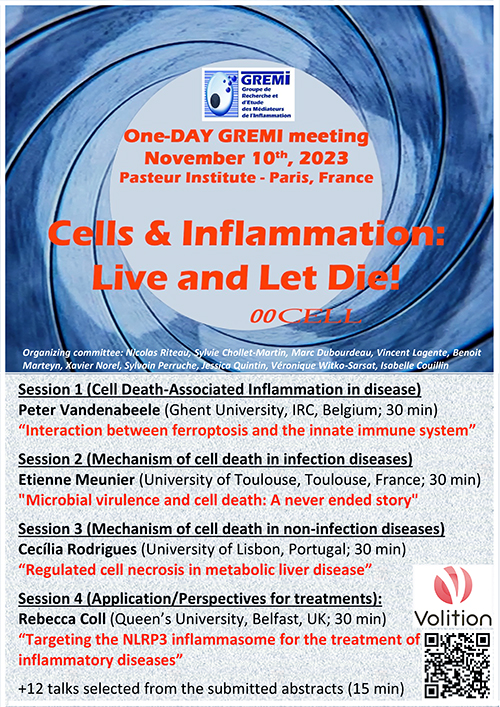
_________________________________________Journée GREMI du 10 Novembre 2023
Les Photos du congrès sont on-line
(si vous souhaitez retirer une photo, envoyer un email à xnorel@hotmail.com)
Inscription - Soumission des résumés